Grand Loaders for Automating Workpiece Transfer to Machine Tools: Features and Key Points for Implementation
Are you experiencing any of the following challenges in your factory’s production processes?
・Operators manually load and unload workpieces to and from machine tools
・Heavy workpieces and repetitive tasks place a significant burden on operators
・An operator must be stationed in front of the machine tool at all times
・Attaching and detaching workpieces takes time, resulting in long machine downtime
・You want to achieve continuous operation at night and on holidays, as well as coordination with multiple machine tools
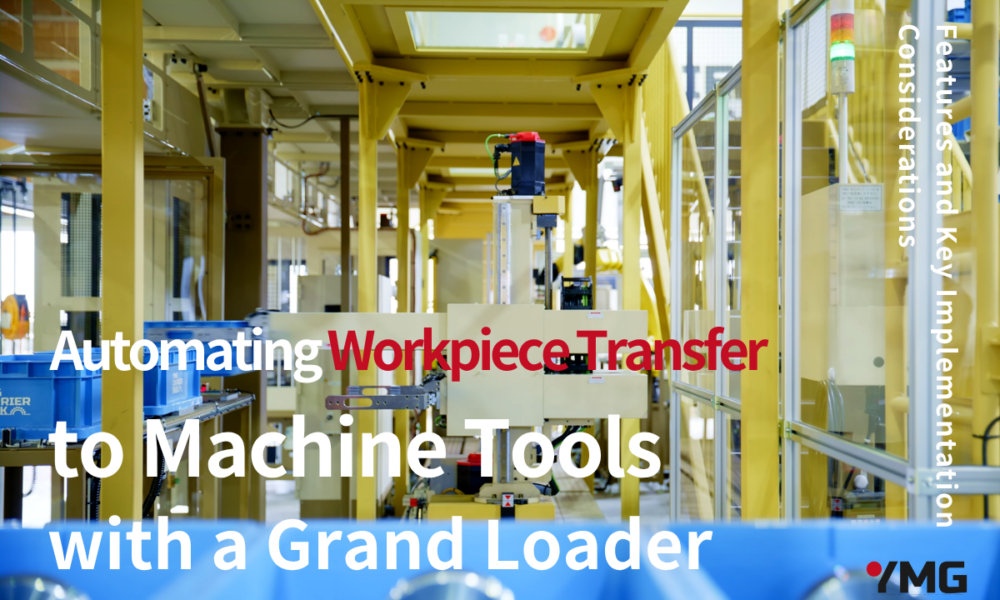
One solution to these challenges is a “grand loader,” which automates workpieces transfer to and from machine tools.
In this article, we introduce common challenges that arise when transferring workpieces in factories, as well as the mechanism and features of grand loaders.
■Common Challenges in Factory Workpiece Transfer
In production using machine tools, it is necessary to load workpieces in to the machine before machining and remove them after machining.
When operators are responsible for these tasks, time is required not only for the machining itself but also for transferring, attaching, and detaching workpieces.
As the number of machine tools increases, or when the process involves mass production with repetitive tasks, workpiece transfer can become a burden on the entire production process.
【Manual Loading and Unloading to and from Machine Tools】
Attaching workpieces to a machine tool before machining and removing them after machining requires a certain amount of time and labor.
When many machine tools are in operation, operators may need to move between multiple pieces of equipment while loading and unloading workpieces.
【Heavy Burden from Repetitive Tasks】
Workpiece transfer and attachment and detachment tend to involve reperirive movements.
In particular, when the same task must be continued for long periods or when handling heavy workpieces, the physical burden on operators may become significant.
【Extended Machine Downtime】
When time is required not only for machining but also for workpiece transfer, attachment and detachment, and setup, the amount of time during which the machine tool is not operating may increase.
To operate machine tools efficiently, it is important to review not only the machining process but also the transfer processes before and after machining.
【Difficulty Achieving Continuous Operation at Night and on Holidays】
When operators manually load and unload workpieces, it becomes difficult to operate machine tools continuously at night and on holidays.
When considering continuous operation, the entire process must be designed to include workpieces supply methods, equipment safety measures, and procedures for responding to abnormalities.
【Uncertainty About Which Automation Equipment Is Suitable for Your Company】
Even when considering automation, there may be cases where it is difficult to determine which process to address first or which type of transfer equipment is suitable.
When selecting equipment, it is important to comprehensively examine not only the specifications of the equipment itself but also the shape and weight of the workpieces, the layout of the machine tools, and the movement paths within the factory.
■How Can Workpiece Transfer Be Automated?
When considering factory automation, it is necessary to examine not only the machine tools themselves but also how workpieces move before and after machining.
Automation may be applied to processes such as the following:
・Supplying and removing workpieces before and after machining
・Handing workpieces over to the inspection process
・Transferring finished products and work-in-process items
The equipment configuration required will vary depending on the range of processes to be automated.
For example, the configuration of the transfer equipment and the required installation space will differ between automating only the loading and unloading of a machine tool and linking multiple machine tools with inspection processes.
First, it is important to organize the tasks that currently require significant time or labor and consider which challenges can be solved through automation.
■Features of the Grand Loaders Manufactured by YMG
The grand loaders manufactured by YMG are devices that pursue the capabilities of linear transfer to the highest possible level. Configured with the minimum number of axes, the loader can rapidly attach and detach workpieces from the front of a machine tool.
YMG grand loaders have the following features.
➀High-Speed Workpiece Loading and Unloading
The loader, configured with the minimum number of axes, streamlines the required transfer movements. The workpiece attachment and detachment time has been reduced to as little as 6 seconds.
By automating the loading and unloading of workpieces to and from machine tools, the system helps improve the efficiency of repetitive tasks previously performed by operators and reduce machine downtime.
②Compact Movement with a Two-Stage Telescopic Design
Grand loaders use a two-stage telescopic design.
A telescopic design is a structure in which multiple components extend and retract. By using a two-stage telescopic design, the overall dimensions of the loader can be kept compact when in retrancts.
This helps reduce the space required for equipment movement, making it possible to consider implementation according to limited installation space in the factory and the layout around existing equipment.
③Agile Movement through Simultaneous Multi-Axis Control
By controlling multiple axes simultaneously, the system achieves agile transfer by combining the movements of each axis. A key feature is that it can smoothly perform workpiece loading, unloading, and transfer movements.
In addition, the main body can be rotated using a turning axis. Because the loader can move while changing its orientation, this function can also be used to pass through narrow spaces depending on the equipment layout and movement paths within the factory.
④Additional Machine Tools Can Be Added as Production Volume Increases
When production volume increases, additional machine tools can be in stalled behind the grand laoder.
Because machine tools can be added while making use of existing equipment, production capacity can be increased gradually in response to changes in production volume.
▸Access the product details webpage here
▾Product introduction and implementation case video
■Feel Free to Consult Us About Your Automation Challengens
Are you facing challenges such as “We want to implement workpiece transfer to and from machine tools,” “We want to reduce the burden of workpiece transfer on operators,” or “We want to know whether a grand loader can be introduced into our production process?”
We accurately assess our customer’s needs and propose comprehensive, creative automation systems suited to their individual circumstances.
At “YMG CARRIER PARK,” a permanent exhibition area for automated transfer equipment located at our factory, you can view transfer equipment in actual operation. There is no need to have a detailed concept finalized in advance.
While observing the equipment’s movements and envisioning how it would operate after implementation, we will work with you to consider an automation method suited to your challenges.
▸Click here to inquire about products and quotations
【Company Profile】
Company Name: YMG Co., Ltd.
Location: 234 Uenoyama, Unoya-cho, Toyohashi City, Aichi, Japan
Representative: Yuichiro Yamamoto, President & CEO
Established: April 1977
Business Description: Design, manufacturing, and sales of auto-loader systems, robotic systems, and factory automation equipment
Website: https://kk-ymg.co.jp/en/
【Product Inquiries】
TEL: +81-532-41-6061
(Business Hours: Weekdays 8:30 AM – 5:30 PM)
Department in Charge: Sales Department 1
【Contact Regarding This Article】
TEL: +81-532-41-6061
(Business Hours: Weekdays 8:30 AM – 5:30 PM)
Department in Charge: Public Relation Department
\ Follow YMG on Social Media! /
We share exclusive content on our social media that is not available on our website.
Through our posts, you can get a closer look at our company culture, atmosphere, and products.
Please be sure to check them out!
★Please like and follow us!